
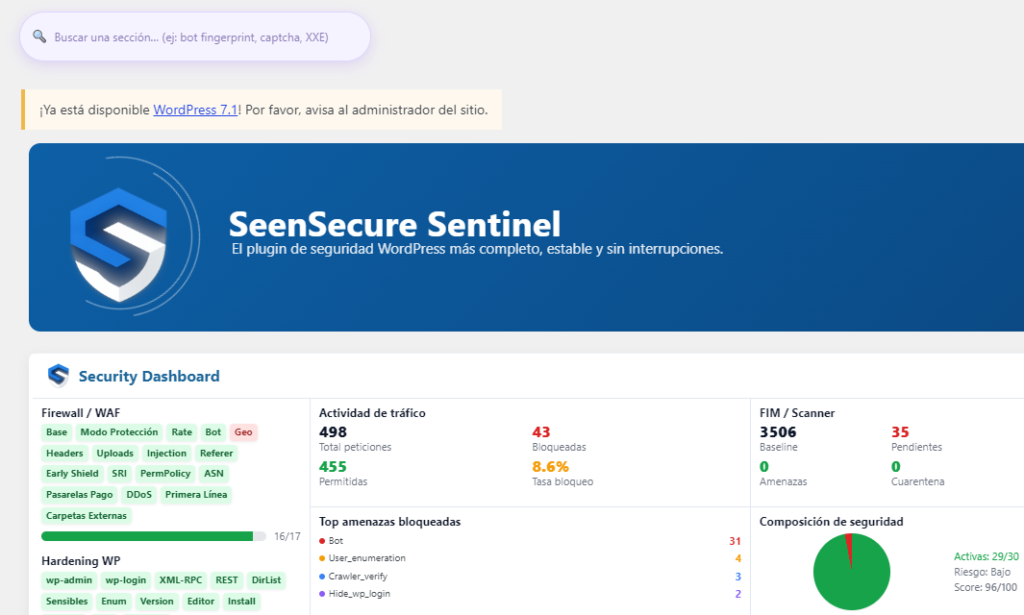
Most security plugins treat “bot blocking” as a single rule: yes or no. SeenSecure splits it into 5 independent layers, each responsible for a different type of suspicious behavior — so a bot might slip past one layer, but not all five at once.
Why a single blocking rule isn’t enough
A bot that only checks the user-agent can easily get past one by changing that value. One that only looks at the IP can rotate IPs. Each individual layer, on its own, has a weak point — real protection comes from combining them, not from having one very strict rule.
SeenSecure’s 5 Anti-Bot layers
1. UA Blocklist (known user-agent list)
The first filter: it compares the declared user-agent against a list of already-identified malicious bots and scrapers. Fast, but insufficient on its own, since anyone can spoof this value.
2. Fingerprint (visitor fingerprint)
Analyzes a set of technical signals from the request (headers, behavior, patterns) to build a fingerprint that tells a real visitor apart from an automated script, even when the user-agent looks legitimate.
3. Crawler Verify (real crawler verification)
When someone claims to be Googlebot, Bingbot, or another known crawler, this layer actually checks it: it does a reverse and forward DNS lookup against the source IP to confirm it really belongs to that company, instead of trusting the claimed name. This blocks bots pretending to be Google without blocking the real Google.
4. Anti-Spoofing (fake IP headers)
Detects when a request tries to spoof the visitor’s real IP through headers like X-Forwarded-For, X-Real-IP, or CF-Connecting-IP, and acts on the true IP, not the one the attacker wants you to see.
5. Threat Intel (threat intelligence)
Compares the source IP against lists of IPs already known for malicious behavior — including, if enabled, the ones SeenSecure’s Protection Network has confirmed on other sites.
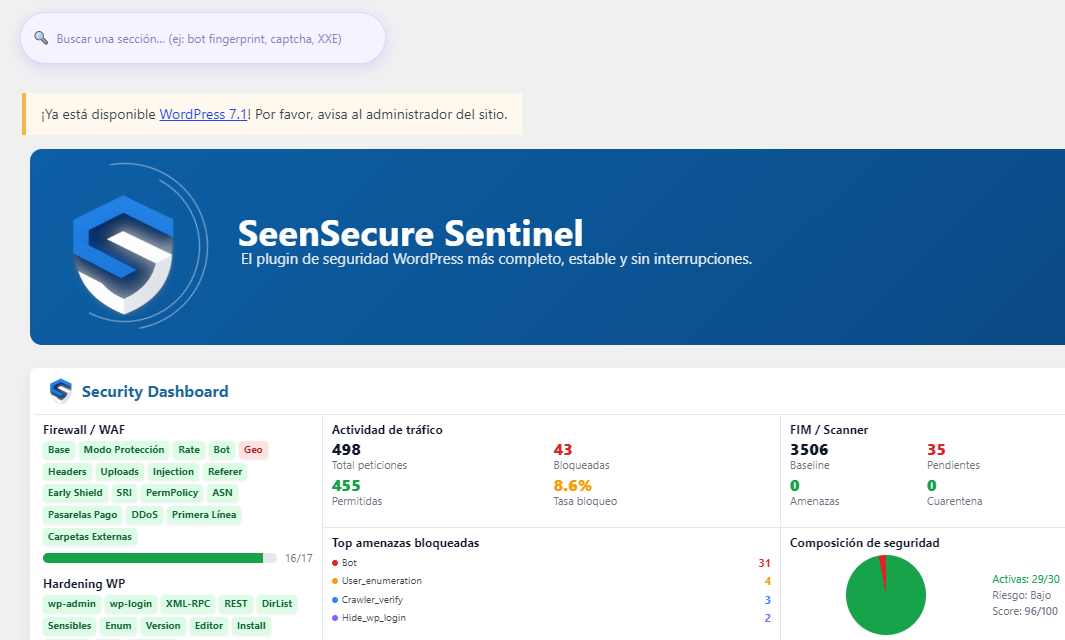
Why this avoids false positives
Since each layer analyzes a different signal, the system doesn’t depend on a single aggressive rule that could mistakenly block a legitimate visitor. A real visitor can fail one ambiguous signal without being blocked if the rest of the layers find nothing suspicious — the final decision combines all the signals, not just one.
Frequently asked questions
Can I disable just one of the 5 layers if it’s causing issues?
Yes, each layer is turned on and off independently from the panel, without affecting the rest.
Does this slow down my site’s load time for real visitors?
Not noticeably — the analysis happens before WordPress even loads, in milliseconds, and doesn’t depend on external requests for every visit.
Why does Google verification matter so much if I already have user-agent blocking?
Because the user-agent can be spoofed with a single line of code — many attackers pose as Googlebot precisely to dodge generic blocks. Without real IP verification, that trick works.